I built a design Q&A app. Here’s everything it does.
ZeroNonsense — AI-powered, gamified, brutally honest design Q&A app for UX and Product designers.
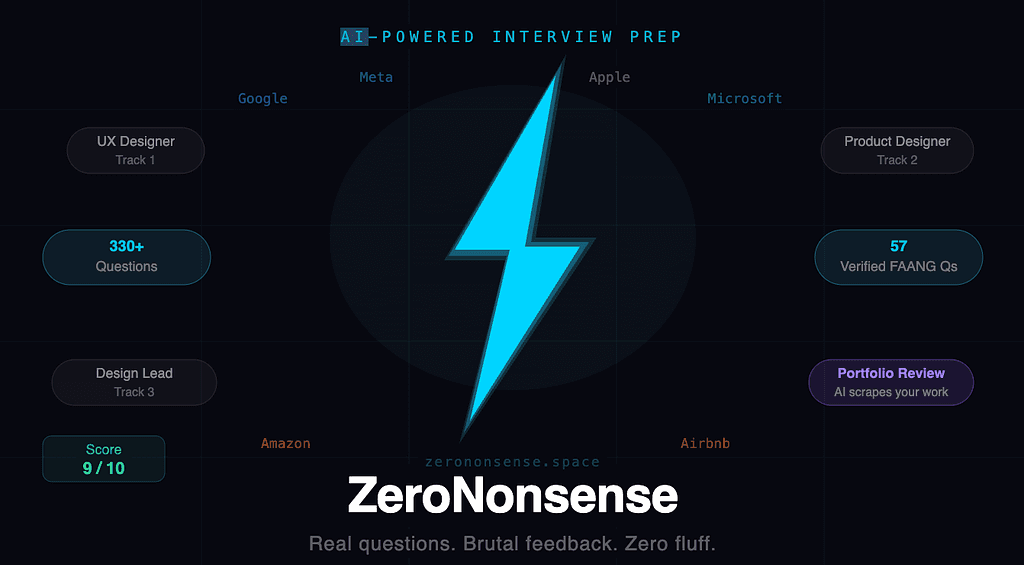
ZeroNonsense — AI-powered, gamified, brutally honest design Q&A app for UX and Product designers.
The problem
I’ve watched designers with genuinely great portfolios fumble FAANG interviews. Not because they didn’t know the answers — they did. But knowing the answer and being able to articulate it clearly, under pressure, to a senior Google or Meta interviewer are two completely different skills.
Generic prep tools treat this like a knowledge problem. It isn’t. It’s a performance problem. You need repetition under simulated pressure, not more flashcards.
That’s the gap ZeroNonsense fills.
What it is
ZeroNonsense is an AI-powered mock interview prep platform specifically built for UX designers, product designers, and design leads targeting top tech companies. It’s gamified , honest like a real interviewer, and built around real questions from actual FAANG interview reports.
Live at: zerononsense.space
The question database
This was the most important thing to get right.
The app has 330+ questions across three tracks and ten difficulty levels. More importantly, 57 of those questions are verified — sourced directly from candidate reports on Glassdoor, Reddit, and Levels.fyi. Word for word, as reported by people who sat across from Google and Meta interviewers.
Questions are tagged by company, type, difficulty, and track. Verified questions get a “Real Interview Q” badge so you know exactly which ones came from real sessions.
The database is split across five question types: portfolio walkthroughs, design challenges, app critiques, behavioral, and research process questions — matching the actual structure of FAANG design interview loops.
Three tracks, ten levels each
The app has three distinct interview tracks:
UX Designer — covers user research, usability testing, information architecture, accessibility, and interaction design. Built for people targeting UX-specific roles at companies like Google and Microsoft where research depth is scrutinised.
Product Designer — end-to-end product design thinking, design systems, cross-functional collaboration, and portfolio depth. Built for Meta, Airbnb, and similar companies where product judgment is the primary signal.
Design Lead — senior questions on strategy, team leadership, stakeholder management, hiring, and measuring design impact at an organizational level. For people targeting staff, principal, or lead roles.
Each track has 10 levels of increasing difficulty. Level 1 questions are appropriate for freshers. Level 10 questions are what you’d expect in a principal designer loop.
How the AI evaluation works
When you submit an answer — by typing or by speaking — it goes to GPT-4o mini with a carefully constructed evaluation prompt that includes:
The question text
Your answer
The difficulty level
The question category
Your experience level (set during onboarding)
The AI returns:
A score from 1–10
A detailed critique of your specific answer
A textbook answer showing what a strong response looks like
A memory hook — a short story or analogy to help the pattern stick
The response format is enforced as JSON so parsing is reliable. The evaluation is calibrated to your experience level — a fresher and a senior get evaluated against different benchmarks.
Voice input
The app supports voice answers via OpenAI Whisper. You click the mic, speak your answer, click stop — Whisper transcribes it and populates the text field. Works on Chrome, Firefox, Safari, and mobile.
This matters because real interviews are spoken. Practicing typed answers only trains half the skill.
The gamification layer
This wasn’t cosmetic — it was a deliberate product decision. People abandon linear prep tools because there’s no feedback loop keeping them engaged.
ZeroNonsense has:
Sparks — a currency earned per question answered, calibrated to your score
Level progression — complete a level to unlock the next
A 7-day streak tracker — shows which days this week you practiced
Session completion screens — total sparks earned, level complete animation
A progress report — category breakdown showing your strongest and weakest areas over time
Focus Queue — dynamically shows your two weakest categories based on actual session history
The world map on the dashboard shows your 10 levels as floating islands connected by glowing cables. It’s genuinely satisfying to watch yourself progress.
Portfolio Review mode
This is the feature I’m most excited about.
After unlocking it, you enter your portfolio URL. The app uses Jina.ai to scrape the content, feeds it to GPT-4o mini, and generates 10 interview questions specifically about your actual work.
Instead of “Walk me through a project where you failed”, you get “You used card-based navigation in your food delivery redesign — what alternatives did you consider and why did you reject them?”
Questions no one else gets. Because they’re about your portfolio specifically.
The technical stack
Frontend: React 18 + TypeScript + Vite + Tailwind CSS
State: Zustand with localStorage persistence
AI: OpenAI GPT-4o mini (evaluation + question generation) + Whisper (voice transcription)
Analytics: Supabase — tracks user name, track, level reached, time spent, sessions completed
Scraping: Jina.ai for portfolio URL content extraction
Deployment: Vercel with custom domain (zerononsense.space)
Auth: None — no accounts, no friction. Progress lives in localStorage.
The whole thing is client-side. No backend server. All AI calls go directly from the browser to OpenAI’s API via environment variables set in Vercel.
What I’d build next
A few things are on the roadmap:
User accounts — cross-device progress sync via Supabase Auth
Community question submissions — let users who’ve had real FAANG interviews submit questions, reviewed before going live
More verified questions — currently at 57, target is 200+
Better assets — the island art is placeholder, planning proper illustrated assets
Try it
zerononsense.space — free to start, no account needed.
If you’re a designer preparing for your next interview at Google, Meta, Apple, Microsoft, or Amazon — this was built for you.
If you find it useful, support the project: razorpay.me/@zerononsense